OptimoRoute is a route optimization platform built for managing pre-planned deliveries. It handles return-to-depot routing and multi-day scheduling, plus navigates driver constraints like work hour limitations or vehicle capacity. Its breadcrumb tracking feature also compares planned routes to actual ones. It holds a 4.6 out of 5 on Capterra. But per-driver pricing with no free tier, desktop-only dispatching, no live traffic integration, and API-only connections to other business management software push many teams to explore other options.
We evaluated 12 delivery management platforms on pricing flexibility, on-demand dispatch capability, mobile dispatching, pre-built integrations, plus verified customer reviews. Here are the seven strongest OptimoRoute alternatives for delivery teams.
OptimoRoute Alternatives Compared
| Provider | Starting Price | Free Tier | On-Demand Dispatch | Mobile Dispatching | Pre-Built Integrations | Best For |
|---|---|---|---|---|---|---|
| Shipday | $0/mo | Yes (300 orders) | Yes | Yes | Yes (Toast, Square, Shopify) | On-demand delivery |
| Routific | $0/mo | Yes (100 orders) | Limited | No | Limited | Planned route optimization |
| Track-POD | $49/driver/mo | No | Limited | No | Zapier only | B2B proof of delivery |
| Onfleet | $599/mo | No | Yes | Yes | Yes | Enterprise last-mile |
| eLogii | Custom quoted | No | Yes | Limited | Limited API + CSV | Mid-market fleet optimization |
| Route4Me | Custom quoted | No | Limited | Limited | API only | Custom routing workflows |
| Spoke Dispatch | $125/mo | No | Yes | Yes | Zapier | Small courier teams |
Start with #1 Shipday Free Today
What OptimoRoute Does Well
OptimoRoute earns strong reviews for a reason. The route optimization engine processes thousands of stops in seconds. Return-to-depot functionality lets drivers reload at a warehouse mid-shift; few competitors handle this well. Weekly planning stretches up to five weeks out. Driver profiles support work hours, lunch breaks, vehicle capacity, hazmat certification, commercial truck routing. The 30-day free trial is generous. Pricing starts at $35.10 per driver per month on an annual plan.
Where Teams Need Something Different
If your operation grows or shifts toward real-time workflows, you’ll likely notice these limitations:
- Per-driver pricing: Costs grow quickly as your team grows.
- No free tier: OptimoRoute offers a 30 free trial, but no free subscription tier.
- Desktop-only dispatching: The mobile app is for drivers, not dispatchers
- No live traffic data: Routes optimize on static maps, so ETAs drift in real conditions
- No pre-built POS or ecommerce integrations: connecting business tools requires developer resources through the API
- No on-demand dispatch workflow: the system assumes all stops are known before the driver leaves
- No AI dispatch tools: OptimoRoute’s rules-based dispatch is customizable, but a lack of built-in AI tools can reduce automation.
OptimoRoute performs well for pre-planned field service, construction routes, trash hauling, or recurring delivery schedules.
However, if your operation handles orders as they arrive, needs dispatching from a phone, or runs on POS software like Toast or Square, the platforms below address those gaps directly.
Best OptimoRoute Alternatives: Descriptions & Reviews
1. Shipday: Best Overall OptimoRoute Alternative
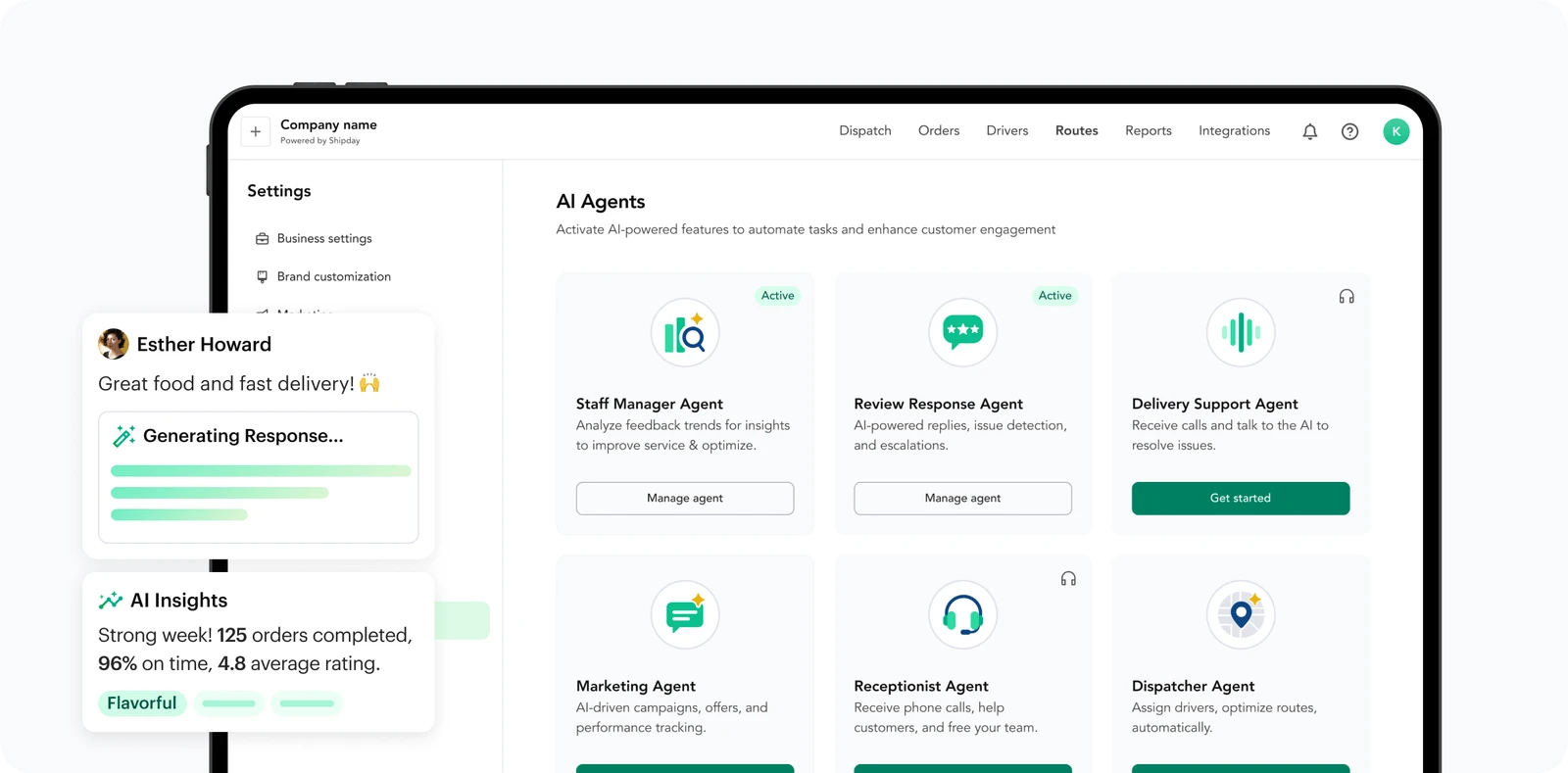
Shipday offers 300 orders per month free with no driver minimums, a major difference from OptimoRoute’s per driver charges with no free tier. Shipday runs the full dispatch workflow from any device; phone, tablet, or computer. Shipday customers report spending up to 60% less time coordinating deliveries after switching from manual dispatch.
The Shipday driver app supports 25+ languages. Dispatchers can reassign stops mid-shift, monitor every driver with live GPS, and send automated customer notifications with tracking links. Shipday also connects directly to multiple POS platforms like Toast, Square, Lightspeed, MICROS and more. Direct ecommerce integrations include Shopify, Squarespace, Wix, Zuppler. These are pre-built connections; no developer resources required. OptimoRoute's API can connect to similar tools, but you typically need to build that connection yourself.
What reviewers say: Shipday holds a 4.7 out of 5 on Capterra. Users praise the ease of use and mention that it helps their business grow. One user says, “Shipday has been a bright light. It's a powerful tool that helps small businesses thrive.”
OptimoRoute vs Shipday at a Glance
| Feature | OptimoRoute | Shipday |
|---|---|---|
| Free tier | ❌ No (30-day trial only) | ✅ Yes (300 orders per month) |
| Built for | ❌ Pre-planned scheduled routes | ✅ On-demand real-time delivery |
| Mobile dispatching | ❌ No (desktop only) | ✅ Yes |
| Driver app languages | ✅ 25+ | ✅ 25+ |
| POS integrations | ❌ API only (developer required) | ✅ Pre-built (Toast, Square, Lightspeed) |
| AI dispatch | ❌ No | ✅ Yes |
| Live traffic routing | ❌ No | ✅ Yes |
| Pricing model | ❌ Per driver ($35.10-$49/driver/mo) | ✅ Flat monthly |
2. Routific
Routific is the closest head-to-head routing competitor to OptimoRoute. The optimization algorithm is well-regarded for pre-planned delivery; customer reviews suggest the interface is cleaner. A free tier covers 100 orders per month; paid plans start at $150 per month for up to 1,000 orders. Routific prices per order rather than per driver, which scales more predictably for teams adding vehicles. It does not support return-to-depot routing or on-demand dispatch. The platform is English-only.
What reviewers say: Routific holds a 4.9 out of 5 on Capterra. Users say the software helps them “quickly manage and optimize delivery routes” without “getting stuck in setup or training.”
3. Track-POD
Track-POD builds deep on proof of delivery. Customizable POD templates, barcode scanning by order or item, partial delivery documentation, bills of lading, cash on delivery are all built in. Plans start at $49 per driver per month with a 3-driver minimum ($147 per month before a single delivery). Route optimization handles large stop counts well. Like OptimoRoute, dispatching requires desktop access. The platform supports seven languages.
What reviewers say: Track-POD averages a 4.7 out of 5 on Capterra. Customers say the platform is “very fast and easy to use” and that their “clients are very satisfied with the notifications and PODs they receive."
4. Onfleet
Onfleet is an enterprise platform for centralized fleet management across multiple locations. Plans start at $599 per month for 2,500 tasks. The platform supports on-demand dispatch, predictive ETAs, auto-routing, barcode scanning, compliance-ready delivery logs. Mobile dispatching works on any device. Onfleet prices per task rather than per driver, which benefits teams with mixed fleet sizes. The price point puts it out of reach for most small operations.
What reviewers say: On G2 and Capterra, Onfleet holds a 4.6 out of 5. Users mention "Onfleet allows us to operate compliantly as close to paperless as we can get” and that it “provides valuable historical data.”
5. eLogii
eLogii is the closest feature-level competitor to OptimoRoute on this list. Both platforms handle constraint-based routing: time windows, driver schedules, vehicle types, load capacity. The difference is that eLogii's optimization engine factors in live traffic conditions. OptimoRoute routes against static map data; eLogii adjusts ETAs in real time as road conditions change. However, Pricing is custom quoted. Third-party sources report starting prices from $159 per month. eLogii does not offer a free tier, though a free trial is available.
What reviewers say: eLogii holds a 4.8 out of 5 on Capterra. One user says the "customizable API interface allowed us to integrate with our ERP pretty seamlessly" and that it "easily increased load density by 10%."
6. Route4Me
Route4Me targets operations that need routing tightly connected to existing business systems. The API integrates with ERPs and supports data export to BI dashboards. Each customer stores photos, notes, plus delivery history for long-term records. The Routes Map feature lets dispatchers drag stops between routes visually. Though pricing is custom-quoted. Route4Me In-app navigation accuracy is also a recurring point of feedback; many teams mention running a third-party map app alongside it.
What reviewers say: Route4Me holds a 4.7 out of 5 on G2 and 4.4 out of 5 on Capterra. One user says, "I enjoy using the Routes Map feature, which allows me to click and drag stops from route to route, saving me a lot of time.”
7. Spoke Dispatch
Formerly Circuit for Teams (rebranded late 2025), Spoke Dispatch is built for small courier and retail delivery teams. Plans start at $125 per month for 1,000 stops, plus $0.04 per stop for any overage. Per-stop pricing is a direct alternative to OptimoRoute's per-driver model; you pay for volume, not headcount. Real-time route editing and stop reassignment work from the dispatcher dashboard.
What reviewers say: Spoke Dispatch currently has only four public reviews on G2, all rated 5.0 out of 5. One positive review mentions, "The support is awesome, we love the UI and snappiness of the web tool and the mobile apps.”
How We Chose These Alternatives
We reviewed each platform against five criteria tied to gaps OptimoRoute users most commonly report:
- Pricing flexibility: We rewarded free tiers, flat-rate plans, or per-order models that stay predictable as teams grow.
- On-demand dispatch capability: We considered whether the platform handles orders arriving in real time, not just pre-planned routes.
- Mobile dispatching: We looked for tools that allow dispatchers to manage routes and reassign stops from a phone.
- Pre-built integrations: We gave the highest scores for direct connections to POS and ecommerce platforms.
- Verified customer reviews: We looked for ratings and feedback from real users on G2, Capterra, GetApp.
All pricing and feature data were verified from publicly available sources in February 2026.
Bottom Line
OptimoRoute is a capable route optimization platform for pre-planned field service. Return-to-depot routing, driver constraint management, competitive per-driver pricing make it a strong fit for construction, food production, and recurring service routes.
Nonetheless, if your delivery operation handles orders in real time, needs flexible mobile dispatching, or connects to POS or ecommerce platforms, Shipday is built for your workflow. No driver minimums, no per-stop fees, 300 orders per month free. The driver app works in 25+ languages on any smartphone.
Frequently Asked Questions
Is OptimoRoute good for restaurant delivery?
OptimoRoute handles route optimization but has no direct POS integrations, no on-demand dispatch workflow. It requires desktop access for dispatching. Shipday connects directly to Toast, Square, Lightspeed; it is purpose-built for on-demand delivery.
Is there a free alternative to OptimoRoute?
Yes. Shipday offers 300 orders per month free with full delivery management features. Routific offers 100 orders per month free. OptimoRoute has no free tier, though it does offer a 30-day free trial.
Can I dispatch from my phone with OptimoRoute?
No. OptimoRoute's mobile app is for drivers only. Dispatchers need a desktop to create routes, edit stops, or reassign drivers. Shipday supports full mobile dispatching on any device.
Does OptimoRoute integrate with POS systems?
OptimoRoute offers an API that can connect to POS systems, but building that connection requires developer resources. Shipday offers pre-built integrations with Toast, Square, Lightspeed, MICROS, Heartland, ePOS Now that work without custom development.

Adem EsenCo-founder, CTO
Automating local deliveries globally. Writes about restaurant delivery management, growing delivery business, integrations and managing profitable restaurants.