The Routific algorithm was designed to eliminate “spaghetti routes.” The straightforward user interface requires no training and the pricing model scales flexibly with order volume. Routific has a strong route optimization platform. It holds a 4.9 out of 5 on Capterra with a positive customer satisfaction score. All of those details are great if Routific is the best fit for your business.
But Routific is designed for pre-planned delivery routes. If your operation involves on-demand dispatch, multilingual driver teams or operates with a POS, you may need a platform that is built differently. We evaluated 12 delivery management platforms that fill gaps in Routific’s platform; here are the 6 best Routific alternatives for teams whose needs extend beyond scheduled route optimization.
Routific Alternatives Compared
| Provider | Starting Price | Free Tier | On-Demand Delivery | Multilingual App | AI Dispatch |
|---|---|---|---|---|---|
| Shipday | $0/mo | Yes (300 orders) | Yes | Yes (25+ languages) | Yes |
| Onfleet | $599/mo | No | Yes | Limited | No |
| OptimoRoute | $35.10/driver/mo | No | Limited | No | No |
| eLogii | Custom quoted | No | Yes | Yes | Yes |
| Route4Me | Custom quoted | No | Limited | No | No |
| Tookan | $29/mo | No | Yes | Yes | No |
What Routific Does Well (and Where Teams Need Something Different)
Routific honestly earns its reputation as one of the best. The route optimization algorithm uses machine learning to produce driver-friendly routes with minimal manual editing. Drag-and-drop editing works in both map and timeline views. Customer notifications include a live tracking link. Pricing is flexible. The free tier covers 100 orders per month. Paid plans start at $150 per month for up to 1,000 orders.
However, the gaps show up in specific use cases:
- On-demand delivery: Routific itself acknowledges that the platform is not a great fit for dispatching on-demand orders.
- Barcode scanning: There is no barcode scanning.
- Return-to-depot routing: is limited to shift-based workarounds.
- Multiple language support: The platform is English-only; non-English speakers are directed to use a Chrome translation extension.
- Integrations: There are no direct POS integrations for restaurants or other POS-dependent businesses.
- Cost: Competitors like Shipday offer a more robust free subscription tier that supports 3 times as many monthly orders.
These might not be dealbreakers for your team. But if your operation depends on one or more of these capabilities, it is worth evaluating platforms that were built with them from the start.
Best Routific Alternatives: Descriptions & Reviews
1. Shipday: Best Overall Routific Alternative
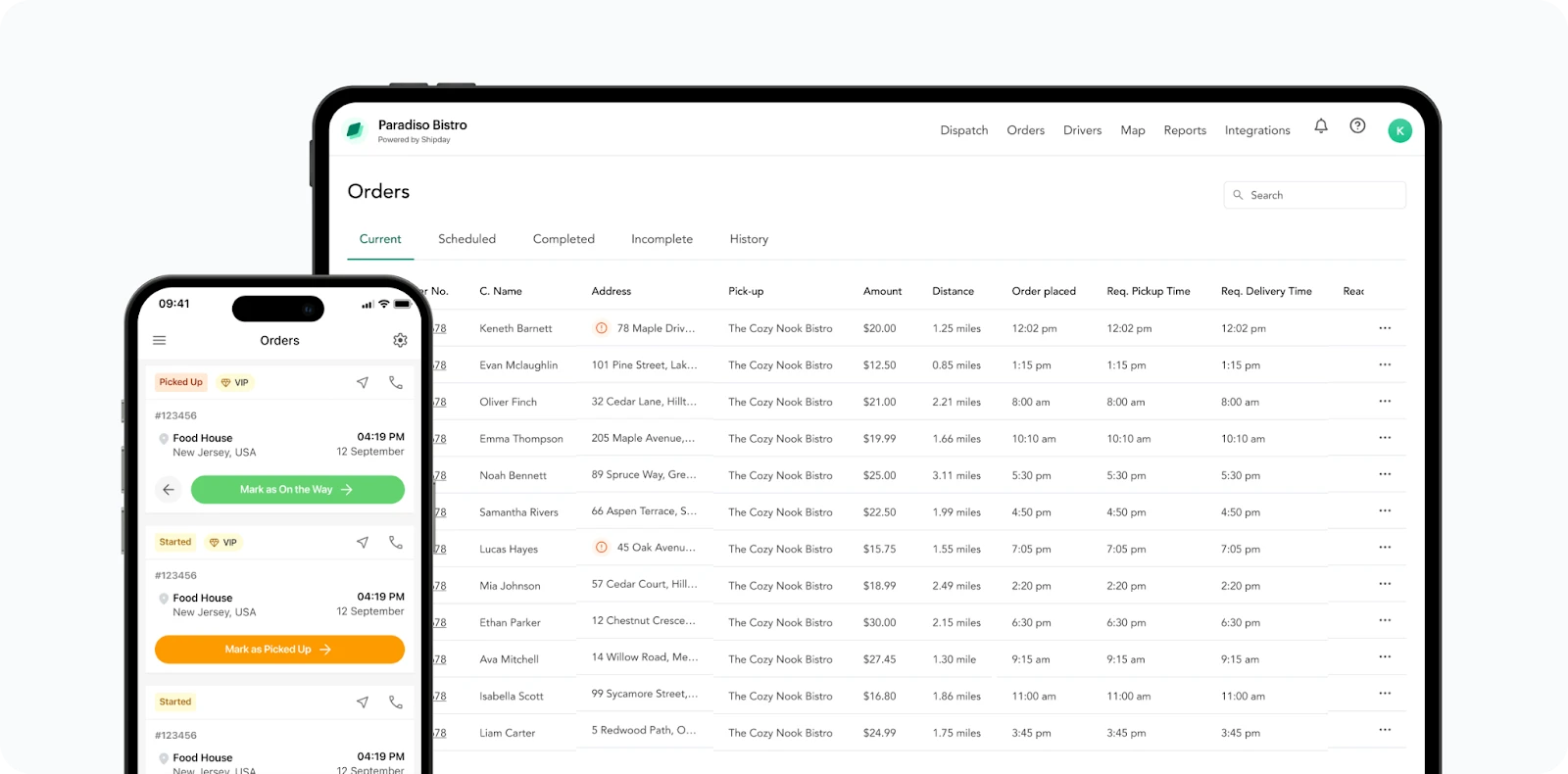
The core difference between Routific and Shipday comes down to the types of delivery operations each supports. Routific excels at pre-planned routes, while Shipday can handle both pre-planned and on-demand delivery.
Shipday's free tier covers 300 orders per month compared to Routific's 100. The driver app runs on any smartphone in 25+ languages, which is a significant gap for operations with multilingual driver teams since Routific supports English only.
Shipday also includes:
- Real-time GPS tracking
- Automated customer notifications with live tracking links
- Photo and signature proof of delivery
- Branded tracking pages
- Integrations with popular POS systems including Toast, Square and Clover
- Integrations with on-demand third-party drivers to supplement your on-house team
Optional AI-powered workflows can handle incoming calls, compose customer review responses, and automatically assign drivers to new orders. Flat monthly pricing means costs stay predictable as your team grows.
Shipday works across industries. Restaurants use it for direct delivery. Pharmacies use it for prescription fulfillment. Courier services use it for last-mile logistics. Enterprise brands like KFC run multi-location operations on Shipday; independent mom and pop shops depend on the affordable platform to grow their business.
What reviewers say: Shipday holds a 4.7 out of 5 on Capterra, with many positive reviews. One restaurant owner sums up their love of this platform, saying, "When I call Shipday with an issue, the phone rings and then a person answers. The person who answers the phone already has my account pulled up, knows who I am, and knows my active orders."
Routific vs Shipday at a Glance
| Feature | Routific | Shipday |
|---|---|---|
| Free tier | 100 orders per month | 300 orders per month |
| Built for | Pre-planned routes | On-demand delivery or pre-planned routes |
| Mobile driver app | Yes | Yes |
| Languages Supported | English only | 25+ languages |
| Proof of delivery | Yes | Yes |
| AI-supported workflows | No | Yes |
| POS integrations | No | Yes (Toast, Square, Clover, Shopify) |
| Customer notifications | Yes (SMS extra) | Yes (included) |
| Pricing model | Per order, scaling | Flat monthly |
2. Onfleet
Onfleet is an enterprise-grade delivery management platform with a strong API and multi-brand capabilities. Plans start at $599 per month. One reviewer compared the API to Stripe's for completeness, calling it an industry standard for logistics teams that want to avoid building in-house.
Onfleet supports barcode scanning, predictive ETAs, auto-dispatch, and compliance features like automated delivery logs. Cannabis dispensaries, construction logistics teams, and direct-to-consumer brands use it heavily. Though multiple reviewers note that SMS and call communications sometimes get flagged as spam by carriers.
What reviewers say: Onfleet holds a 4.6 out of 5 on both G2 and Capterra. One Capterra user says, "Onfleet has a product that is adaptable to diverse industries.”
3. OptimoRoute: Best for Field Service and Return-to-Depot Routes
OptimoRoute addresses one of Routific's most commonly cited gaps: return-to-depot routing. If your drivers make multiple trips back to a warehouse or depot throughout the day (common with small vehicles, bikes or e-bikes), OptimoRoute handles this natively rather than through shift-based workarounds.
Per-driver pricing starts at $35.10 per month on an annual plan. The platform is popular with lawn care companies, trash hauling services, and field service teams. Live tracking supports real-time rerouting and dynamic ETAs. Users should note that the mobile app is driver-only and route editing requires a desktop computer. There is also no free tier.
What reviewers say: On Capterra, OptimoRoute earns a 4.6 out of 5 and 4.8 out of 5 on G2. Positive reviews mention "accurate routes” and say the platform “improves overall workflow efficiency.”
4. eLogii
eLogii offers advanced customization by product categories (ambient, frozen, fragile), configurable driver skills, vehicle load planning by volume and weight, multi-depot fleet sharing, multi-day routing, and date-range planning up to weeks ahead.
eLogii provides live driver tracking with dynamic ETAs, (which Routific does not fully support). Barcode scanning is also included. The task-based pricing structure can also make eLogii more economical than per-driver models for larger fleets. Though custom-quoted pricing means you need to contact the eLogii sales team for pricing.
What reviewers say: eLogii holds a 4.5 out of 5 on G2. Independent reviewers highlight its scalability for mid- to large-sized fleets that have outgrown simpler route-optimization tools.
5. Route4Me
Route4Me is built for teams that need deep integration between their routing platform and existing business systems. The API supports ERP connections, data export for business intelligence dashboards and custom workflow automation. Photo and note storage per customer creates a running record of delivery history.
Some users have been on the platform since 2014. In-app navigation accuracy remains a common complaint; most teams use a third-party map app alongside Route4Me. As of January 2026, pricing is no longer publicly available and the free trial has been discontinued.
What reviewers say: Route4Me holds a 4.7 out of 5 on G2 and 4.4 out of 5 on Capterra. Users note that it “makes routing simple yet effective” and “The user experience is seamless, intuitive, and fast.”
6. Tookan
Tookan from Jungleworks takes a modular approach to delivery management. The base platform starts at $29 per month for 200 tasks. From there, you add features through paid add-ons: route optimization, SMS notifications, customer portals, vertical-specific platforms for laundry services, catering, cannabis delivery and waste collection.
But the costs can add up. Building functionality comparable to Routific or Shipday requires stacking multiple paid add-ons. Review sentiment is sharply divided. Long-term users praise the tracking and delivery management flexibility. Recent reviewers describe support problems, broken feature promises and refund disputes.
What reviewers say: Tookan holds a 4.2 out of 5 on G2 and 4.1 out of 5 on Capterra. Positive reviews mention that the software “saves time & money” and that the app is “easy to use and modern.”
How We Chose These Alternatives
We evaluated each platform on five criteria: affordability, core delivery features, ease of use, scalability, and verified customer reviews from G2, Capterra, and other public sites. We prioritized platforms that address Routific's specific use-case gaps: on-demand dispatch, barcode scanning, multilingual driver support, return-to-depot routing, and mid-shift route editing. All pricing was verified in February 2026.
Bottom Line
Routific is a great route optimization platform for pre-planned delivery operations. If your business runs scheduled routes for meal kits or subscriptions, Routific is hard to beat.
But if you need on-demand delivery, a multilingual driver app, AI-powered dispatch, POS integrations, or a free tier that scales past 100 orders per month, Shipday picks up where Routific leaves off. Three hundred orders per month free, a driver app in 25+ languages, real-time tracking, proof of delivery, and flat pricing that grows with your operation.
Start with Shipday Free Today →
Frequently Asked Questions
Is Routific good for restaurant delivery?
Routific works for pre-scheduled restaurant deliveries like meal prep and catering. For on-demand restaurant delivery, where orders go out as they come in, Routific themselves recommend other platforms. Shipday is purpose-built for on-demand restaurant delivery with POS integrations and branded customer tracking.
Is there a free alternative to Routific?
Shipday offers 300 orders per month free with full delivery management features. Routific offers 100 orders per month free for route optimization.
Can Routific handle on-demand delivery?
Routific is designed for pre-planned routes, not on-demand dispatch. For on-demand operations, Shipday is a free, purpose-built alternative.

Adem EsenCo-founder, CTO
Automating local deliveries globally. Writes about restaurant delivery management, growing delivery business, integrations and managing profitable restaurants.