

Which Delivery Management Software Actually Scales Last- Mile Delivery?


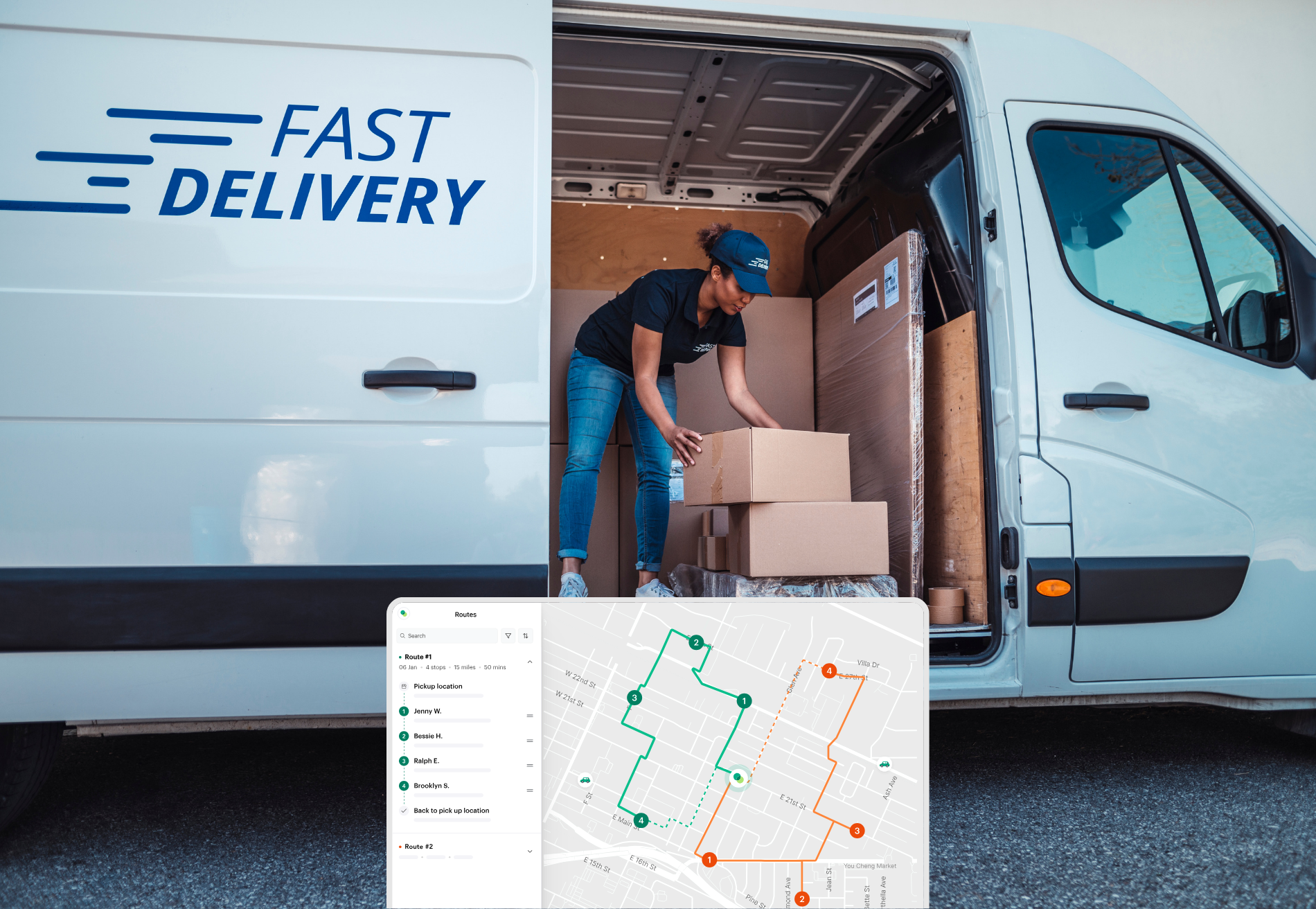
What got your operation here won't get it there.
Orders are running well, drivers are covering their routes, and customers aren't complaining. But growth is coming with more locations, climbing volume, and tools that work today but have a ceiling. The hard part is knowing which platform is best suited to the business you're on the path to becoming.
There's no universal best pick because operations break in different ways as they scale, and different platforms are built for different breakpoints. Naming the top delivery management software providers for scalable last-mile delivery only helps if the list is organized by which wall you're about to hit, not by rank.
What scalable last-mile delivery actually means
Scalable last-mile delivery means handling more orders, more locations, more drivers, and more territory without costs or operational chaos rising in step. A platform scales when it automates what used to require additional headcount, automatically absorbs volume spikes, and keeps cost-per-delivery stable as the business grows.
In practice, that doesn't show up as a clean curve on a chart. It shows up as a dispatcher who used to finish assignments before lunch and now can't get through them by 6 pm, a second location that runs nothing like the first despite using the same software, or a per-driver fee that was a rounding error at five drivers and is now a line item someone has to defend. None of that means the software got worse. It means the operation outgrew what the tool was built to handle, and the feature set and pricing model both decide how soon that happens.
The five walls that operations hit as they scale
Growth doesn't randomly break delivery operations. It breaks them at five predictable points, each one a specific moment the team will recognize.
The dispatcher can't keep up. This is the volume wall. The person who handled 50 orders a day in a spreadsheet becomes the bottleneck at 200 orders a day. The manual assignment that took 20 minutes now takes two hours.
The second location breaks the system. This is the multi-location wall. A second or third location means separate driver pools and no unified view. What worked at one site doesn't transfer to three.
Two driver pools, one dispatcher. This is the mixed fleet wall. In-house drivers run alongside third-party couriers like DoorDash or Uber, often during rush periods or as overflow during expansion. Without a platform built for both, the dispatcher manages two systems to run one operation.
The map gets bigger than the logic. This is the geographic expansion wall. New zones introduce longer routes and delivery windows that don't behave like those in the original territory. Route logic that worked locally doesn't automatically optimize across regions.
The bill stops making sense. This is the cost model wall. A per-driver fee that felt fine at 10 drivers looks very different at 50. The platform that got the business through early growth becomes the very thing actively taxing its next stage.
Diagnose your wall before you shop for software
Most software comparisons start with the vendors. This one starts with the wall, because the wall determines which vendors are even worth comparing.
Before looking at any platform, get specific about which of the five is closest. Not which one sounds most urgent in the abstract, but which one is actually showing up in the operation right now or in the next two quarters. An operation adding a second location has a different problem than one running flat at one site but drowning in order volume. An operation that just signed its first third-party courier contract has a different problem than one eyeing expansion into a new state.
Naming the wall first changes the question from "what's the best delivery software?" to "what's the best delivery software for this specific problem?" That's a question with an actual answer.
Which software is built for which wall
The volume wall
Shipday and Wodely fit early- to mid-volume growth. Shipday's per-order pricing keeps costs predictable as order counts climb, with the dispatcher's job handled by software rather than a spreadsheet; Wodely runs a similar model at $49 per month for 400 tasks.
Onfleet is the step up once routing complexity grows alongside volume: $619 a month for 2,500 tasks, $1,349 for 5,000, $3,099 for 10,000 and above, unlimited users throughout. Routific and Tookan sit closer to Shipday's tier — Routific is free under 100 orders and $150 a month up to 1,000 with no per-driver fee, Tookan charges $39 to $499 by task volume, though route optimization there is a paid add-on rather than included.
The multi-location wall
Onfleet handles multi-location visibility well, providing a single view of driver pools and routes regardless of site count. DispatchTrack is built for fast multi-site rollout, with deployments to hundreds of locations within weeks.
Shipday supports multiple locations, but it fits a business that is still bringing its delivery setup together better than one running a large distributed network with meaningfully different routing needs at each site.
The mixed fleet wall
Shipday's direct integration with DoorDash and Uber is a real advantage for SMBs that need overflow capacity without a dedicated carrier partnership. Two driver pools, one dispatcher screen — in-house and third-party drivers run from the same dashboard.
Bringg is the enterprise answer, orchestrating in-house fleets alongside third-party carrier networks for clients including Walmart and Coca-Cola. The pricing reflects that scope: per-driver fees between $100 and $300 a month, plus implementation costs that often reach five or six figures. Below roughly 500 drivers, that math doesn't make sense.
The geographic wall
This is the one wall where SMB-tier tools mostly aren't the answer, worth saying plainly instead of stretching a platform to fit. Third-party driver coverage and multi-region routing logic are enterprise territory — Onfleet operates in more than 60 countries, but most SMB and mid-market tools are built around a single country or a handful of them.
Shipday's strongest footprint is the US, Canada, and Australia. Routific, Tookan, and Route4Me are similarly solid within their home markets, but none are built for true multi-region expansion.
The cost model wall
The pricing model, not the feature list, decides this one.
Bringg's per-driver fee penalizes fleet growth directly. Route4Me does something similar from a different angle: per-user pricing plus a marketplace of paid add-ons for features other platforms include standard, so the quoted price and the real bill rarely match. Onfleet's per-task tiers are predictable, with a clear cost at each volume level before you hit it. Shipday's per-order model carries no per-driver fee — a real structural advantage for a growing fleet — with one caveat: the math changes once volume clears the included threshold. The $39 Professional plan includes 300 orders; overage applies above that limit. Third-party delivery fees through DoorDash or Uber are billed on top, starting around $6.49 per delivery.
This is the wall where "what got you here won't get you there" shows up most literally. The pricing model that made sense at 10 drivers is, in some cases, the one working against the operation at 50.
Provider comparison
Where Shipday fits, and where it doesn't
Shipday is the strongest fit for three of the five walls: volume growth at the SMB and mid-market level, mixed fleets that need third-party overflow without a full carrier partnership, and cost models where per-driver fees would otherwise punish growth. As a last-mile delivery platform, its case rests on per-order pricing, fast setup, and native integrations with DoorDash and Uber — routes that adjust themselves as the day unfolds instead of a plan made once each morning.
It's not the right tool for every wall. An operation that monitors the second location for system breaks and runs a distributed network with different routing logic at each site is better served by Onfleet or DispatchTrack. An operation expanding into true multi-region territory needs country coverage, which no SMB-tier platform currently offers. And an operation with more than 500 drivers and complex multi-carrier orchestration needs is past the point where Shipday, or most mid-market tools, makes sense. That's Bringg's use case.
That scoping is the point. A framework that says one tool wins everything isn't a framework. It's a pitch with extra steps.
How to choose for the scale you're heading toward
A few questions worth answering before evaluating platforms:
Where is the order volume heading in six months? Approaching a few hundred orders a day makes auto-dispatch and route optimization a requirement, not a nice-to-have.
Are locations getting added? Multi-site visibility and fast rollout matter most here. A platform that's great at one location and manual at two isn't a scaling solution.
Will in-house and third-party drivers run together? Confirm the platform handles both natively. A workaround at low volume becomes a liability at high volume.
What does growth do to the bill? Model the overage at double the current volume, and separately model what a per-driver fee would cost at double the current fleet size. Those are different numbers, and they tell different stories.
How fast does this need to be live? A six-to-twelve-month enterprise implementation solves the right problem on the wrong timeline for most growing operations.
Shipday, Onfleet, Routific, and Tookan all help SMB and growing mid-market operations scale delivery operations honestly. Bringg is built for a different problem, priced and scoped accordingly.
FAQ
What is the best delivery management software for scaling last-mile delivery?
It depends on which wall the operation is hitting. For SMB and mid-market operations, Shipday and Onfleet handle volume growth cleanly, Shipday with per-order pricing and no per-driver fees, Onfleet with per-task tiers and strong route optimization. Routific and Tookan are budget-tier alternatives worth a look at the same scale. For enterprise operations managing hundreds of drivers across regions, Bringg offers orchestration at a scale and cost that match that complexity.
What makes delivery management software scalable?
A scalable platform automates dispatch and routing so that volume growth doesn't require proportional growth in headcount, and it keeps cost per delivery stable as the operation expands. Pricing model matters as much as features: per-driver fees penalize fleet growth directly, while per-task or per-order pricing scales more predictably with volume.
Can free or low-cost delivery software handle scale?
Up to a point. Shipday's free tier covers up to 10 drivers and 300 orders a month; Routific's free tier covers up to 100 orders with no driver limit. Past that, paid tiers with auto-dispatch and route optimization become necessary — Wodely starts at $49 a month for 400 tasks, Onfleet at $619 for 2,500.
What happens when an operation mixes in-house and third-party drivers?
Most platforms handle one well and the other as an afterthought. Shipday integrates directly with DoorDash and Uber, so restaurants and couriers running both fleets at once manage both driver types from one dashboard. At enterprise scale, Bringg is purpose-built for mixed-fleet orchestration across carrier networks, though its pricing and implementation requirements put it out of reach for most SMB and mid-market operations.
Does scalable last-mile software work for multi-location businesses?
Yes, though support varies by platform. Onfleet offers strong visibility across driver pools and routes at multiple sites. DispatchTrack is built for fast multi-site rollout and is widely used in mid- to large-scale distribution. Shipday supports multiple locations, but fits an operation that is still consolidating better than one running a large, complex distributed network.
The tool for the wall you're about to hit
What got the operation here won't get it there. The setup that handles 50 orders a day buckles at 500. The dispatcher managing everything by phone becomes the bottleneck. Routes that worked across two zones fall apart across five.
The best scalable last-mile delivery software is the one built for the wall closest to the operation right now, priced so growth doesn't get taxed along the way. For a lot of growing SMB and mid-market operations, that's Shipday. For others, it's honestly one of the platforms named above instead.
See which wall Shipday solves for your operation — start free, no card required.
Pricing data sourced from publicly available materials as of June 2026. Enterprise pricing for Bringg and DispatchTrack, and quote-based pricing for Route4Me, is not publicly disclosed and is derived from third-party review platforms and competitor analysis. Verify current pricing directly with vendors before making purchasing decisions.




.avif)
Índice
Artículos relacionados

¿Listo para empezar?
Juega primero con él, agrega tu equipo y paga después.


%201.svg)

.svg)